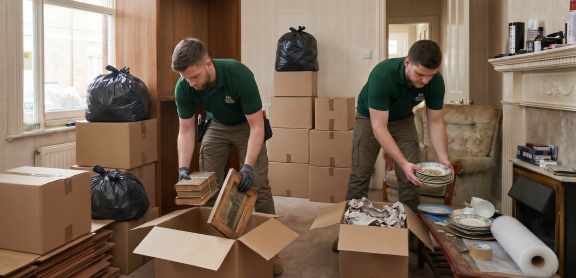
House clearance involves removing unwanted items from a home, such as furniture and general clutter, and disposing of them through donation, recycling, resale, or waste removal.
A house clearance is often required when downsizing, after a bereavement, or to clear a home where hoarding has taken place through a hoarder house clearance. These types of clearances are usually larger in scale and therefore have higher clearance fees than smaller jobs, like clearing unwanted items at the end of a tenancy. It’s always best to explain the reason for your clearance to the company you choose so they can provide an accurate quote.
Whatever your reason for needing a clearance company, we've explored why a professional company is recommended, how they can assist you, and what the costs may be.
Do I Need a Clearance Company or Can I Do It Myself?
Taking on a clearance yourself can be time-consuming, involve heavy lifting and sometimes dirty items, and you will likely require a car or van. While it may seem like the cheaper option, in practice it often comes with extra challenges.
Charity shops often restrict what and when they’ll accept donations. Hiring a skip can be costly, may need a council permit, and risks other people dumping their waste. Recycling centres usually require proof of address, involve multiple trips, and can leave your car dirty or damaged.
In contrast, a licensed clearance company offers convenience, flexibility and protection from fly-tipping. Using an unlicensed carrier that fly-tips your waste could leave you facing a fine of up to £1,000. [1]
The Advantage of a Clearance Company
For anything beyond a very small job, we recommend hiring a professional house clearance company - it’s easier, safer and less stressful.
A clearance company will:
Clear everything: They'll be able to remove almost every type of item
Dispose of items properly: No fly-tipping or illegal disposal of goods
Handle the logistics: They will know exactly how and where to recycle, donate, or sell items
Save you time and stress: Clearances are tough, especially after a bereavement. Professionals make the process quicker and more manageable
Some house clearance companies may visit the home to determine the size of the job. Properties with a large volume or specialist items will require more hours and staff, driving the price up.
Many companies offer additional clearing services, such as carpet cleaning and garden clearance. If this is required, you'll need to let the company know in advance. Be sure to ask for a full quote breakdown, including VAT, before booking a company.
2
Instruct the Clearance Company
Provide the date of the clearance, the address of the home and any instructions you have. For example, make the company aware of what rooms are to be cleared or any areas of the home that are off-limits.
3
Prepare the Property
Any goods you want to keep should be set aside or removed from the home before the clearance, including items you wish to sell privately. Making the property as accessible as possible will minimise the risk of delays or issues on the day.
4
Clearance Day
On the day of the clearance, the team will arrive at the agreed time and begin removing items from the property. They’ll work through each room according to your instructions, separating anything that has been marked for donation, auction, or disposal.
Items for charity or auction will be loaded and taken directly to the relevant shop or auction house. Recyclable goods are sorted and sent to a recycling centre, while everything else is disposed of responsibly in line with local regulations.
Most companies will also sweep through the property once it’s cleared, leaving it tidy and ready for sale, letting, or renovation.
Industry Insight: Bereavement Clearances
"The jobs that go wrong are almost always bereavement clearances where the family hasn't had time to go through everything properly. I've seen cases of clearance teams accidentally disposing of cash hidden in mattresses, jewellery left in coat pockets, important documents in desk drawers. If you're clearing a deceased relative's home, I'd strongly recommend doing one slow walk-through, checking every drawer, pocket, and container, before the clearance team arrives. They work fast by design as they're removing, not searching."
Dave Sayce, Founder, Konnect You
How Much Does It Cost?
The average clearance cost is between £705 and £1,148. Your house clearance costs will depend on various factors, including:
The property size and location
The volume of items
The type of items
The number of staff members needed for the job
The size and number of vehicles and equipment required
What Can’t House Clearance Providers Take?
Most house clearance companies remove a wide range of household items, but there are certain things they can’t legally or safely collect or dispose of.
These often include:
Asbestos
Weapons or ammunition
Chemicals and hazardous substances (e.g. paint, solvents, pesticides)
Professional clearance companies that hold a Waste Carrier Licence will likely follow the waste management hierarchy, which is:
Prevent
Reduce
Reuse
Recycle
Responsible disposal
Many clearance companies will find the most sustainable way to dispose of items. If something cannot be sold or donated, it will likely be taken to a recycling centre.
As a last resort for items that cannot be handled by the first four steps of the waste hierarchy, they are taken to be incinerated or to a landfill.
How to Find a House Clearance Company
Here are the top ways to find and choose the right clearance company for you:
1
Use Trusted Comparison Sites
Comparison sites connect users with clearance companies in their area. You’ll be asked some questions to ensure they fit your criteria.
You’ll have the opportunity to discuss your requirements with each match beforehand. With probate clearances, choosing a company that specialises in this area will ensure the job is completed with sensitivity and consideration.
2
Ask for Recommendations and Read Reviews
If any friends or family have used house clearing services, it can be good to get a firsthand account of their experience. Reading reviews is also a good indicator, as they are unbiased and honest.
3
Check Companies via the Environment Agency
Companies carrying waste in a commercial capacity must have a Waste Carrier Licence. You can confirm their company licence number on the Environment Agency website.
Find Trusted Clearance Companies
Find a clearance company that suits your needs, budget, and job. Fill in our simple form and we’ll connect you with clearance professionals who meet our standards. You can review your options and save up to 70% on your fees.
Every company must pass our verification process before joining our network. We require clearance companies to hold a Waste Carrier Licence and Public Liability insurance, so you can feel confident your clearance is handled by regulated professionals.
FAQs
Some companies may give you the option. If the clearance follows a bereavement, it can be an upsetting day for loved ones, so many companies will let you choose whether you want to be at the home during the clearance.
Some cleaning companies estimate the cost of valuable items found and subtract the amount from the clearance cost. If the estimated amount is higher than the cost, the clearance company will pay you the difference. Not all companies offer this service, so make sure to check before hiring them.
Councils offer bulky waste services, but they can be limited, and prices will differ depending on the local authority. Many can only take a few items at a time, and you will need to book an available slot.
Some charities offer clearance services, but often only for items that they can sell. Anything not in saleable condition or without a statutory fire‑safety label will not be accepted.
How We Get Our Cost Data
Life's big decisions deserve cost information you can trust. The figures in this guide are based on real prices received by thousands of Konnect You users. We review this data regularly to keep it accurate and up to date, so it reflects what people are really paying. Read more about how we get our cost data.